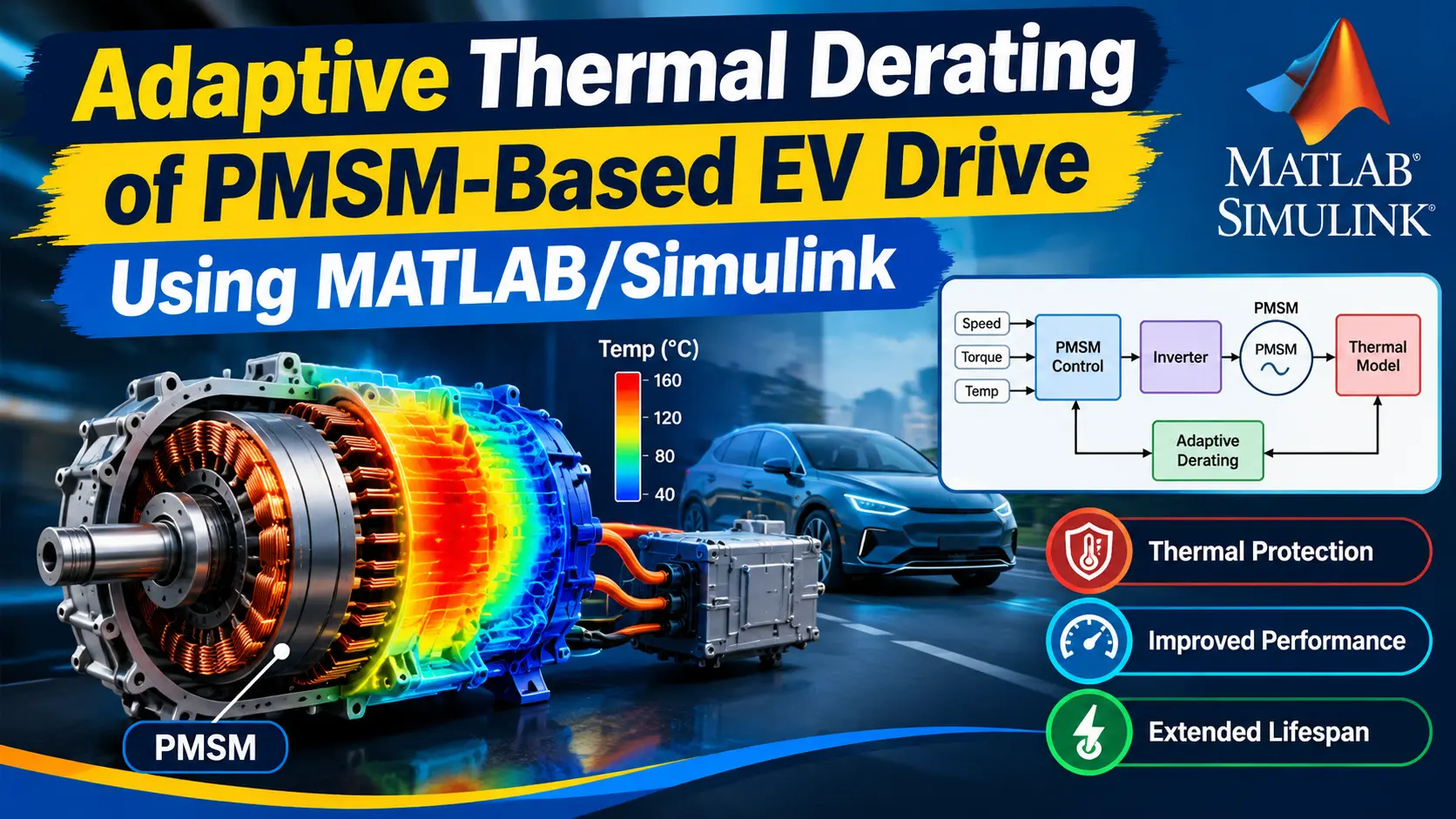
What is Adaptive Thermal Derating of PMSM-Based EV Drive Using MATLAB Simulink?
Adaptive Thermal Derating of PMSM-Based EV Drive Using MATLAB Simulink is a MATLAB-based technical project and simulation model. Permanent Magnet Synchronous Motors (PMSMs) are widely used in electric vehicle (EV) propulsion systems because of their high efficiency, power density, and dynamic performance. However, high ambient temperatures and demanding driving conditions can increase motor and controller temperatures, potentially affecting the reliability and performance of the EV drive. In this project, an adaptive thermal derating control strategy is developed using MATLAB Simulink, where the PMSM torque is automatically reduced when the motor/controller temperature exceeds 80°C. The system considers 40–50°C ambient temperatures to represent high-temperature operating conditions and evaluates the effectiveness of thermal derating in maintaining safe and reliable operation.
Project Methodology
- PMSM-Based EV Drive Model:
A PMSM-based electric vehicle propulsion system is developed in MATLAB Simulink. The model consists of the PMSM, inverter, DC-link, motor controller, vehicle load, and measurement blocks. - PMSM Motor Configuration:
The PMSM is configured using appropriate electrical and mechanical parameters, including rated power, rated voltage, stator resistance, dd- and qq-axis inductances, permanent-magnet flux linkage, pole pairs, inertia, and maximum operating speed. - EV Drive System:
The PMSM is connected to a three-phase inverter and vehicle mechanical load. Vehicle parameters such as vehicle mass, wheel radius, rolling resistance, aerodynamic drag, and gear ratio can be incorporated to calculate the required traction torque. - PMSM Control:
A Field-Oriented Control (FOC) strategy is implemented to regulate PMSM torque and speed. The three-phase currents are transformed into the rotating dqdq reference frame, allowing independent control of the motor current components. - Torque Reference Generation:
The accelerator or vehicle speed command generates the required torque reference. Under normal thermal conditions, the controller allows the motor to follow the requested torque. - Thermal Model Development:
A thermal model is incorporated to estimate the motor/controller temperature during operation. Motor losses, particularly electrical losses associated with current flow, are considered as sources of heat. - High Ambient Temperature Conditions:
The simulation considers ambient temperatures between 40°C and 50°C to represent demanding hot-weather operating conditions. Different ambient temperatures can be tested to evaluate their effect on motor temperature and thermal derating. - Temperature Monitoring:
Motor/controller temperature is continuously monitored using the thermal model. The measured temperature is supplied to the adaptive derating controller. - 80°C Thermal Threshold:
An 80°C temperature threshold is defined as the point at which thermal derating begins. Below this threshold, the requested torque can be maintained, subject to other motor and inverter limits. - Adaptive Torque Derating:
When the temperature exceeds 80°C, the controller progressively reduces the allowable torque reference. This prevents the motor from continuing to operate at high torque and generating excessive additional heat. - Current Limitation:
Because PMSM torque is related to the motor current, the derating controller also limits the allowable current command. The modified current reference is supplied to the PMSM controller to reduce motor loading. - Thermal Derating Algorithm:
The derating factor can be made temperature-dependent. For example, the controller can maintain full torque below the threshold and progressively decrease the maximum allowable torque as temperature increases toward the critical temperature. - High-Load Driving Conditions:
The EV drive is tested under demanding operating conditions such as rapid acceleration, continuous high-speed operation, high-load operation, and repeated acceleration. These conditions are used to generate increased motor temperature. - Different Ambient Temperature Tests:
Simulations are performed at 40°C, 45°C, and 50°C ambient temperatures. The motor temperature, torque limitation, current, and vehicle response are observed for each condition. - With and Without Thermal Derating:
Two simulation cases are compared: a conventional PMSM drive without adaptive thermal derating and the proposed drive with temperature-based torque limitation. This demonstrates the effect of the proposed protection strategy. - Performance Monitoring:
Important parameters including motor temperature, controller temperature, electromagnetic torque, motor speed, dd-axis current, qq-axis current, phase current, DC-link voltage, and vehicle speed are monitored. - Thermal Protection Analysis:
The temperature response is analyzed to determine whether the adaptive controller prevents the system from continuing to operate at excessive thermal conditions. - Result Evaluation:
The results are evaluated based on temperature reduction, torque response, current limitation, speed tracking, and overall EV drive performance. The objective is to achieve a balance between thermal protection and available vehicle performance.
Verified MATLAB Simulation Code Demonstration
Syntax-highlighted executable code demonstration for Adaptive Thermal Derating of PMSM-Based EV Drive Using MATLAB Simulink:
% Dynamic Physical Model & Solver Configuration
clc; clear; close all;

% Hydraulic & Mechanical ODE System Parameters
m = 1.0; c = 0.5; k = 9.0;
ode_sys = @(t, y) [y(2); -(c/m)*y(2) - (k/m)*y(1)];

% Numerical ODE Integration
tspan = [0 10]; y0 = [1.0; 0.0];
[t, y] = ode45(ode_sys, tspan, y0);

fprintf('ODE Physical System Solved across %d Time Steps!\n', length(t));