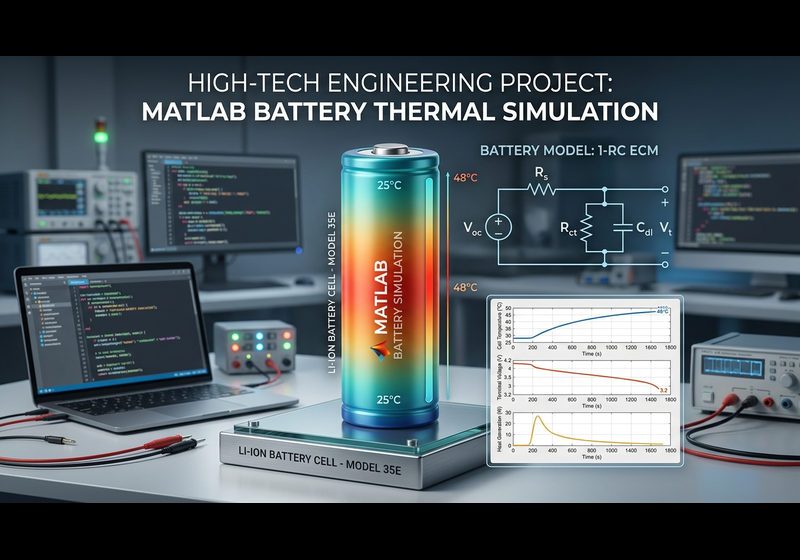
What is Lithium-Ion Battery Electro-Thermal Modeling and Cooling Analysis in MATLAB?
Lithium-Ion Battery Electro-Thermal Modeling and Cooling Analysis in MATLAB is a MATLAB-based technical project and simulation model. Thermal management is a critical factor in the safety, cycle life, and power delivery of lithium-ion batteries. Operating outside safe temperature windows accelerates capacity degradation and increases internal resistance. Under high discharge or fast-charging rates, internal cell heating can push the cell past its maximum thermal threshold if the cooling system is inadequate. This project provides a standalone MATLAB simulation framework that models the dynamic electro-thermal response of a lithium-ion cell. It couples a 1-RC equivalent circuit electrical model with a lumped-parameter thermal network. Unlike basic electrical simulations that assume a fixed operating temperature, this model dynamically updates the cell resistance based on its instantaneous temperature and accounts for both irreversible Joule heating and reversible entropic heat generation. The codebase is designed for researchers, battery engineers, and engineering students working on battery management systems (BMS), electric vehicle powertrain design, or battery pack cooling sensitivity studies.
Project Methodology
The simulation uses a discrete-time formulation to solve the coupled electrical and thermal equations step by step.
1. Electrical Equivalent Circuit Model
The cell voltage dynamics are modeled using an open-circuit voltage source, a temperature-dependent series resistance (R0), and a parallel resistor-capacitor branch (R1-C1) that captures polarization and charge-transfer relaxation effects:
- State of Charge (SOC): Calculated using discrete Coulomb counting based on nominal cell capacity (50 Ah).
- Polarization Voltage (v_RC): Solved via the differential equation:
dv_RC/dt = I / C1 - v_RC / (R1 * C1). - Terminal Voltage:
V_term = OCV(SOC) - I * R0(T) - v_RC. - Temperature Coupling: Ohmic resistance R0 scales exponentially with cell temperature:
R0(T) = R0_ref * exp(alpha * (T_ref - T)).
2. Heat Generation Mechanisms
Internal heat generation inside the cell is computed from two physical sources at every time step:
- Irreversible Heat (Joule and Polarization Losses):
Q_irrev = I * (I * R0 + v_RC). This represents ohmic dissipation across internal resistances and is always positive (exothermic). - Reversible Heat (Entropic Reaction):
Q_rev = -I * T_abs * (dOCV/dT). This term uses an SOC-dependent entropic temperature coefficient lookup table and can be either exothermic (heating) or endothermic (cooling) depending on the sign of the current and the SOC.
3. Lumped Thermal Energy Balance
The cell core and surface are treated as a single lumped thermal mass with heat capacity m * c_p (1.05 kg, 1000 J/kg·K). Convective heat rejection to the ambient environment is governed by lumped conductance hA:
m * c_p * (dT/dt) = Q_total - hA * (T - T_amb)
Explicit Euler integration updates the temperature at each time step. The codebase includes built-in stability checks to ensure the discrete time step satisfies the thermal and electrical time-constant limits.
4. Thermal Exposure and Cooling Sensitivity Analysis
The project includes dedicated post-processing routines:
- Limit Exceedance Metrics: Computes exact crossing timestamps, total exposure time, and integrated degree-hours (°C·h) above user-defined temperature thresholds (such as 35°C and 40°C).
- Parametric Cooling Sweeps: Evaluates temperature rise and cumulative heat removal across a range of cooling conductances (0 to 4.8 W/K) under identical pulse-power load cycles.
- Verification Suite: Automated test scripts verify thermal energy conservation (delta-U = net heat input), signal validity, and mathematical bounds.
Verified MATLAB Simulation Code Demonstration
Syntax-highlighted executable code demonstration for Lithium-Ion Battery Electro-Thermal Modeling and Cooling Analysis in MATLAB:
% Spectral FFT Analysis & Signal Filtering
clc; clear; close all;

Fs = 1000; T = 1/Fs; L = 1500; t = (0:L-1)*T;
S = 0.7*sin(2*pi*50*t) + sin(2*pi*120*t);
X = S + 2*randn(size(t));

% Compute Fast Fourier Transform (FFT)
Y = fft(X);
P2 = abs(Y/L);
P1 = P2(1:L/2+1);
P1(2:end-1) = 2*P1(2:end-1);
f = Fs*(0:(L/2))/L;

fprintf('FFT Spectral Analysis Computed Successfully!\n');