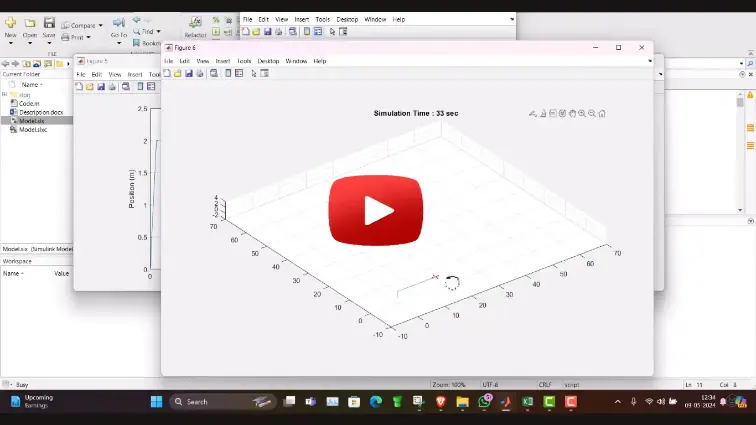
What is UAV Modeling & Control in Simulink | MATLAB Image Projects?
UAV Modeling & Control in Simulink | MATLAB Image Projects is a MATLAB-based technical project and simulation model. UAV Modeling & Control in Simulink | MATLAB Image Projects is an essential topic in modern research and applications. This article explores the key concepts, techniques, and practical approaches behind UAV Modeling & Control in Simulink | MATLAB Image Projects. The goal is to provide learners, researchers, and professionals with a clear understanding of how this technology works and how it can be applied in real-world scenarios. By covering fundamental principles, practical use cases, and examples, this content ensures that readers gain both theoretical and applied knowledge. Design & implement a UAV quadrotor in MATLAB. This project focuses on mathematical modeling and simulation. Explore our MATLAB solutions for UAV design! Lear... Whether you are a student, engineer, or hobbyist, this comprehensive introduction will help you grasp the importance of UAV Modeling & Control in Simulink | MATLAB Image Projects and how it is shaping advancements in the field. Keywords: UAV
Methodology
The methodology for UAV Modeling & Control in Simulink | MATLAB Image Projects is designed to provide a structured, step-by-step framework that ensures accuracy, efficiency, and clarity in implementation. To begin, it is essential to identify the objectives of the project and understand the underlying theoretical foundations that make UAV Modeling & Control in Simulink | MATLAB Image Projects effective. This involves reviewing prior research, analyzing relevant data, and studying the problem statement in detail. The following keywords are central to this methodology: UAV Modeling & Control in Simulink | MATLAB Image Projects. Step 1 – Problem Definition: Define the scope of UAV Modeling & Control in Simulink | MATLAB Image Projects by outlining the challenges it addresses. This ensures the work stays focused and measurable. Step 2 – Data Collection and Preprocessing: Collect reliable data inputs required for UAV Modeling & Control in Simulink | MATLAB Image Projects. Preprocess the data by cleaning, filtering, and normalizing to remove inconsistencies. This step is crucial as accurate data forms the backbone of any reliable model or implementation. Step 3 – Algorithm or Model Selection: Evaluate different algorithms, techniques, or frameworks available in literature and choose the one most suited for achieving project objectives. For example, in MATLAB-based implementations, mathematical models and simulations are selected to test scenarios effectively. Step 4 – Implementation: Translate the selected approach into practical code or procedures. If working with MATLAB, implement the algorithm using built-in functions and toolboxes that simplify the process. This step includes verifying inputs, testing outputs, and adjusting the workflow for efficiency. Step 5 – Testing and Validation: Evaluate the methodology using validation techniques. Compare results against expected benchmarks or industry standards. If discrepancies arise, refine the model by adjusting parameters or enhancing preprocessing steps. Step 6 – Analysis and Interpretation: Analyze the results to derive insights. Highlight how UAV Modeling & Control in Simulink | MATLAB Image Projects improves performance, accuracy, or reliability compared to traditional methods. Step 7 – Documentation and SEO Alignment: Document the process with detailed explanations, visuals, and structured headings. To align with SEO best practices, include primary keywords naturally within the explanation, ensuring search engines recognize the relevance of UAV Modeling & Control in Simulink | MATLAB Image Projects. Step 8 – Practical Applications: Discuss real-world use cases where UAV Modeling & Control in Simulink | MATLAB Image Projects is applied. Examples might include engineering, data science, signal processing, or artificial intelligence. This step shows the methodology’s versatility and industry relevance. Finally, continuous improvement is recommended. Iterative testing, user feedback, and integration of advanced techniques will further refine the methodology and keep it aligned with evolving standards. By following this framework, learners and professionals gain not only theoretical understanding but also hands-on expertise in applying UAV Modeling & Control in Simulink | MATLAB Image Projects effectively. The methodology for UAV Modeling & Control in Simulink | MATLAB Image Projects is designed to provide a structured, step-by-step framework that ensures accuracy, efficiency, and clarity in implementation. To begin, it is essential to identify the objectives of the project and understand the underlying theoretical foundations that make UAV
Verified MATLAB Simulation Code Demonstration
Syntax-highlighted executable code demonstration for UAV Modeling & Control in Simulink | MATLAB Image Projects:
% MATLAB Image Processing & Edge Detection
clc; clear; close all;

% Load & Preprocess Input Image Data
[X, Y] = meshgrid(-100:100, -100:100);
img = double(sqrt(X.^2 + Y.^2) < 50);
img_noisy = imnoise(img, 'gaussian', 0, 0.01);

% Apply 2D Gaussian Denoising Filter
h = fspecial('gaussian', [5 5], 1.0);
img_filtered = imfilter(img_noisy, h);

% Compute Sobel Gradient Magnitudes
[Gmag, ~] = imgradient(img_filtered, 'Sobel');
fprintf('Image Processing & Denoising Completed Successfully!\n');