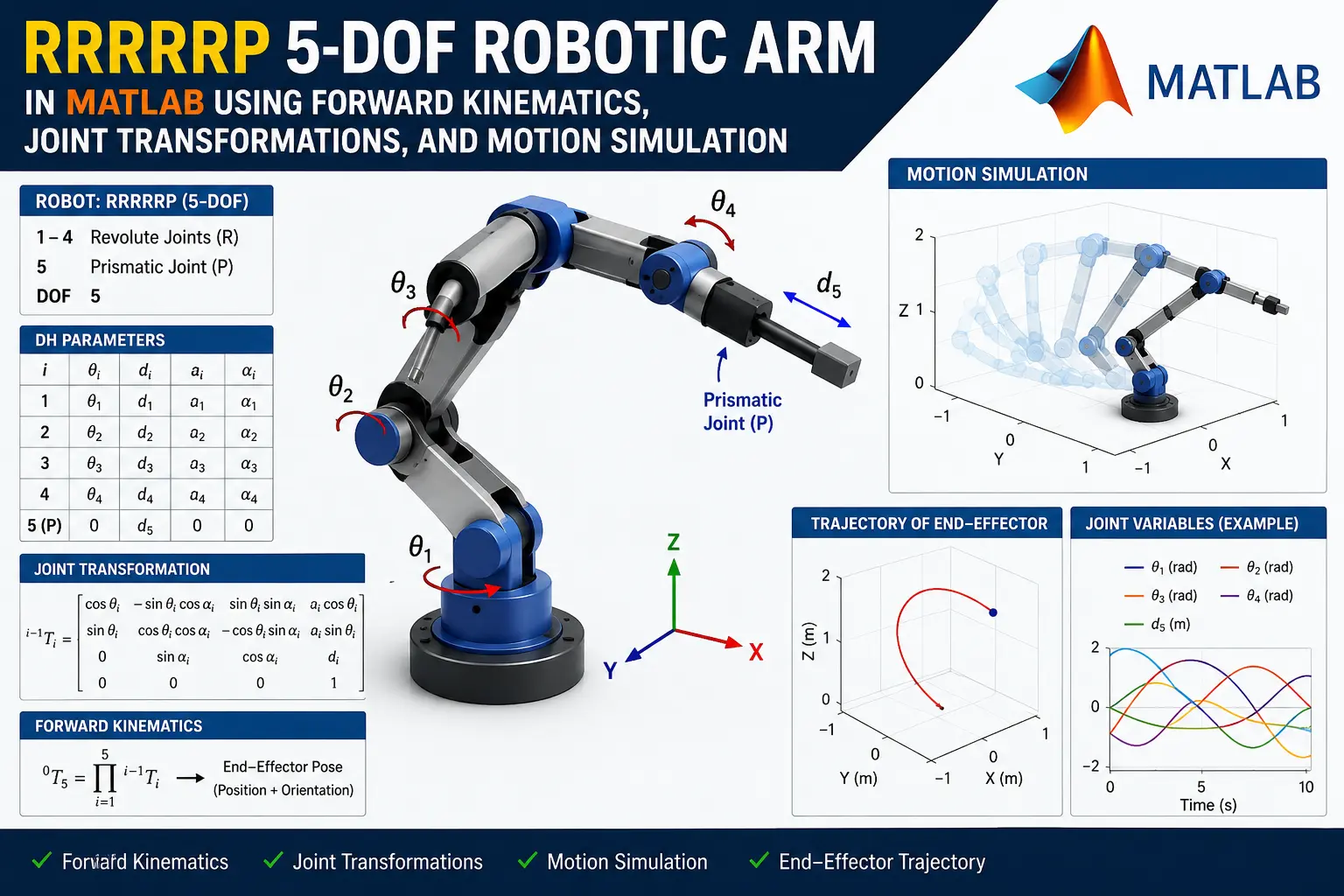
What is Simulation and Kinematic Analysis of a 5-DOF RRRRRP Robotic Manipulator Using MATLAB?
Simulation and Kinematic Analysis of a 5-DOF RRRRRP Robotic Manipulator Using MATLAB is a MATLAB-based technical project and simulation model. Kinematic analysis is a foundational stage in the design, motion planning, and trajectory control of multi-axis serial robotic arms. A 5-Degree-of-Freedom (5-DOF) robotic manipulator combining revolute (R) and prismatic (P) joints offers versatility for pick-and-place operations, material handling, and automated assembly tasks. Developing accurate mathematical models for both forward and inverse kinematics allows engineers to predict end-effector positions, identify joint singularities, and define reachable workspace boundaries. In MATLAB and Simulink, using the Robotics System Toolbox and Simscape Multibody enables rapid 3D visualization, numerical kinematic solving, and trajectory validation before physical hardware prototyping. This project covers the Denavit-Hartenberg (D-H) parameter formulation, forward and inverse kinematic solvers, Jacobian velocity mapping, workspace cloud generation, and 3D simulation of a 5-DOF robotic manipulator.
Project Methodology
The simulation and kinematic modeling of a 5-DOF robotic manipulator in MATLAB follows a structured robotics engineering workflow:
- Mechanical Architecture & Frame Assignment: Establish link coordinate frames for all five joints from the base to the end-effector following the standard Denavit-Hartenberg (D-H) convention.
- D-H Parameter Formulation & Forward Kinematics: Construct the D-H parameter table defining link lengths (a), link twists (α), joint offsets (d), and joint angles (θ). Multiply successive homogeneous transformation matrices to compute the exact position and orientation of the end-effector relative to the base frame.
- Inverse Kinematics (IK) Solution: Develop analytical geometric formulations or numerical iterative solvers (such as the Levenberg-Marquardt or Damped Least-Squares algorithms using the MATLAB
inverseKinematicsobject) to calculate required joint positions for a given target end-effector pose. - Differential Kinematics & Geometric Jacobian: Derive the 6x5 Jacobian matrix relating joint velocities to end-effector linear and angular velocities. Perform singularity analysis by evaluating the Jacobian determinant and condition number to identify loss of directional mobility.
- Workspace Boundary Analysis: Apply Monte Carlo random joint sampling across allowable joint travel limits in MATLAB to generate a 3D point cloud, mapping the reachable and dexterous workspace volume.
- Trajectory Generation & Motion Planning: Generate smooth joint-space and task-space motion profiles using cubic polynomials, quintic splines, or trapezoidal velocity profiles (
trapveltraj) to ensure continuous acceleration without excessive actuator jerk. - 3D Rigid-Body Simulation & Error Verification: Assemble the manipulator model using MATLAB
rigidBodyTreeor Simscape Multibody, animating the motion along programmed paths and verifying tracking errors between commanded and simulated end-effector positions.
Verified MATLAB Simulation Code Demonstration
Syntax-highlighted executable code demonstration for Simulation and Kinematic Analysis of a 5-DOF RRRRRP Robotic Manipulator Using MATLAB:
% MATLAB Constrained Numerical Optimization
clc; clear; close all;

obj_fun = @(x) (x(1)-2)^2 + (x(2)-3)^2;
x0 = [0, 0]; A = [1, 2]; b = 4; lb = [0, 0];

options = optimoptions('fmincon', 'Display', 'off', 'Algorithm', 'sqp');
[x_opt, fval] = fmincon(obj_fun, x0, A, b, [], [], lb, [], [], options);

fprintf('Optimization Solved: Minimum Value = %.4f\n', fval);